* Yana Levy is a Shansi fellow from the US based in Banda Aceh who teaches English at Universitas Syiah Kuala
Three years have passed since the Rohingya boats first landed on the shores of Aceh. The women and children who arrived on the brink of starvation — fleeing genocide in Myanmar, and dire conditions in the world’s largest refugee camp in Bangladesh, still remain without meaningful access to basic services. According to UNHCR 2025 data, across refugee camps along Aceh’s eastern coast, 390 Rohingya refugees continue to live in limbo[1], with little access to formal education. For women and girls in particular, opportunities to learn, study, or build independence remain painfully limited.
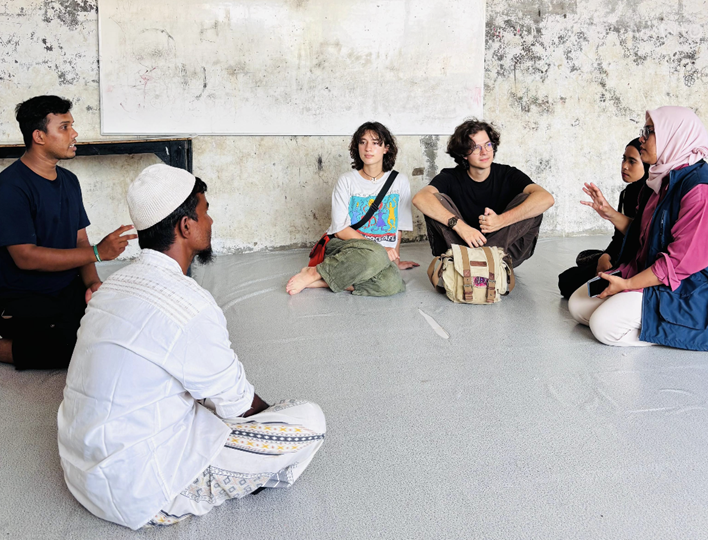
In October of 2025, I was first introduced to the Rohingya communities living in Aceh. Yayasan Solidaritas Aksi Peduli (YSAP), a grassroots NGO based in Lhokseumawe invited my colleague and I to participate in a ‘peace camp’ designed to bring together local and Rohingya youth, increasing tolerance and understanding.
As part of the program, we visited the abandoned immigration office that now serves as a home to the 90 Rohingya in Lhokseumawe. Inside, we saw the conditions they live in: multiple families sharing a single room, separated only by clotheslines draped with sarongs sewn together into makeshift partitions. These thin barriers offered little privacy, and the sounds of conversation, children playing, and everyday life carried easily from one family’s space to another.
I also noticed how people drifted aimlessly through the courtyard, while many of the women sat quietly together with little to occupy their time. Without access to work or school, life in the camps has become one of enforced waiting. In Aceh, access to formal education for Rohingya children is also not yet available. Meanwhile, Rohingya children grow up with severely limited access to education, as IOM and other international organizations struggle to come up with programming in the wake of major budget cuts following the dissolution of USAID in 2025.
Despite these circumstances, they insisted on offering us food, a few women gathered to prepare instant noodles for us, and although we declined because we had already eaten, their generosity stayed with me.
One young woman, Noor, spoke more English than the others. Her face brightened when I mentioned that I was an English teacher. She explained that her husband was fairly proficient in English and they practiced together whenever they could.
Then, shyly, she asked me,
“Will you teach me English ma’am?”
I told her I would.
The Rohingya are one of the world’s largest displaced communities and access to education remains limited wherever they seek refuge. Women and girls face the greatest barriers. Cultural norms and the legacy of gender-based violence often makes families reluctant to educate their daughters, especially when their expected roles are confined to marriage and motherhood. Yet denying girls an education only deepens their vulnerability to child marriage, poverty, and further violence.
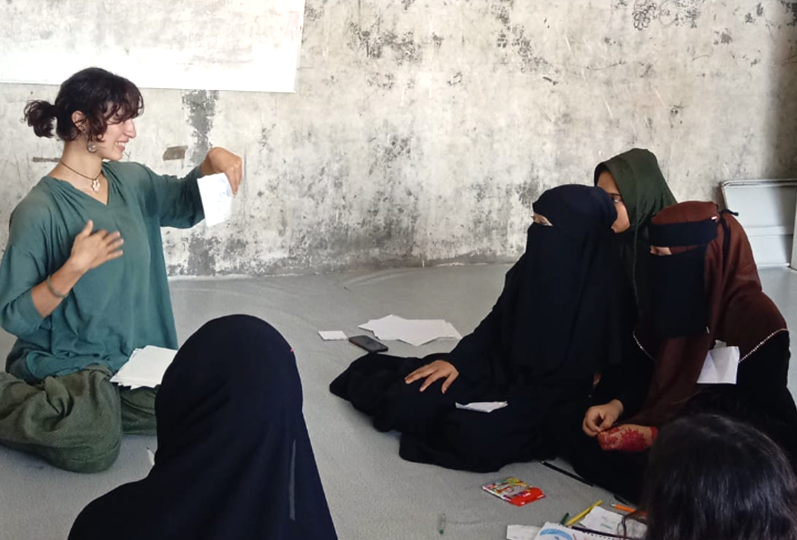
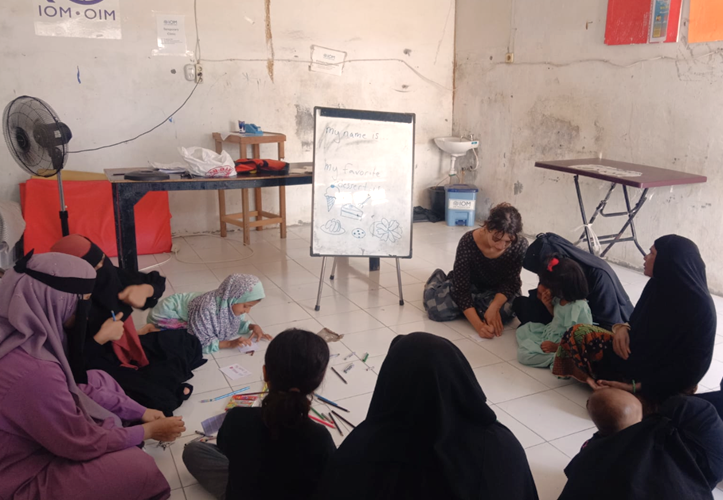
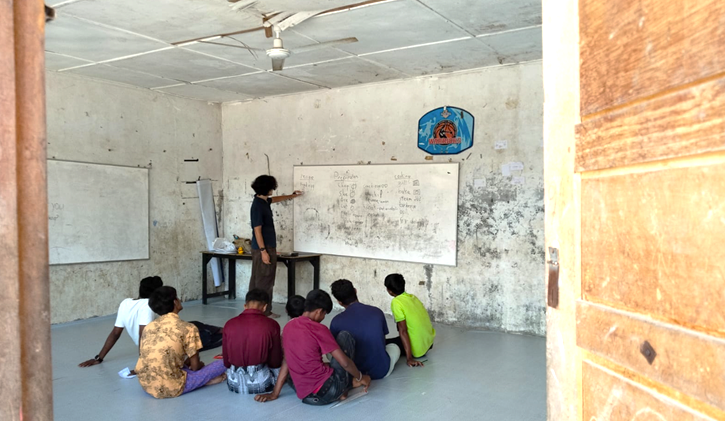
My chance to keep my promise to Noor came in March 2026. After months of researching trauma-informed pedagogy, and coordinating plans with YSAP and our contacts in Lhokseumawe, my colleague and I returned to Lhokseumawe to teach in person for two weeks at the refugee camp. Together we taught 45 students — 25 men and 20 women. Classes were held for two hours each day, with the men meeting in a classroom and the women gathering separately in the camp clinic.
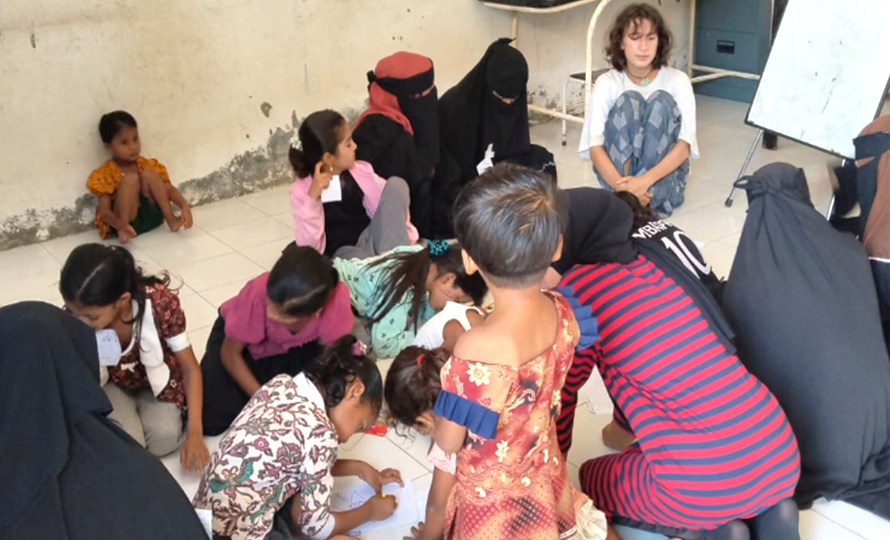
Challenges presented themselves immediately. The clinic, a small chaotic room crowded with medical equipment, felt heavy and airless without a fan. Within ten minutes, I was drenched with sweat. Then there was the noise. For women and young girls, a non-negotiable part of their domestic responsibility involves caring for young family members. They brought babies, toddlers and young children into the classroom, who screamed and cried throughout the session.
My students ranged in age from eight to fifty-six, and many had never experienced a formal classroom setting. Most were deeply shy and hesitant to speak, and when they did, their soft voices were drowned out by the cries and clatter of the children. Most of the women wore the niqab, leaving me to only hope that beneath the fabric covering the lower half of their faces they were smiling.
I ended that first class dehydrated, exhausted, but determined. These women have faced displacement, violence, and uncertainty, yet they still arrived eager to learn. Certainly I could teach through a bit of heat and chaos.
The first woman to arrive each day was always Amina — at fifty six, she was the oldest member of both our class, and the camp. She would sit down right next to me and immediately begin chatting away in Rohingya, as if I could completely understand. Over time, I did come to learn a few words from her, enough to greet her with Toy ken a see (How are you?). She would always respond with a shrug and a grimace, pointing to her back to indicate the pain she was in.
Class would start the same way each day: students made nametags decorated with drawings answering the day’s question — What’s your favorite color? What’s your favorite food? I always wrote Amina’s name for her. One day as I taped the nametag to her chest, she spoke to me urgently in Rohingya. I turned to one of the more advanced students to translate. “She wants to thank you for helping her,” the student explained.
“She used to be able to write her own name,
but it’s been so long now that she’s forgotten how.”
By the end of the course, I suspected Amina had taught me more Rohingya than I had taught her English. Still, she became the heart of the classroom through her unwavering attendance and enthusiasm. Every time she successfully said a full sentence — “My name is Amina” — the whole class would erupt into applause, and her face would light up with a huge smile.
While the class was generally shy and reluctant to participate, I could always rely on an enthusiastic sister duo: Noor (older) and Razia (younger), to chime in and break the silence. Like many Rohingya families theirs has been divided by displacement. The sisters live in Lhokseumawe with their mother, while their father works in Malaysia, sending money to supplement the small allowance provided by IOM.
One day, when it was just the two of us, Razia told me how much she missed her father. “He is a good man,” she said, “not like other fathers.” She explained that many Rohingya men who leave for Malaysia eventually take new wives there, abandoning the families they left behind after years of separation with no clear end in sight.
Even with a father still supporting them from afar, Razia and Noor remain vulnerable as a household of women living alone in the camp. Noor— who told me she was eighteen though she looked younger — had recently married, a decision that, in many ways, secured greater protection for her family. Yet she was fortunate in another sense too: her husband encouraged her education rather than limiting her solely to domestic responsibilities.
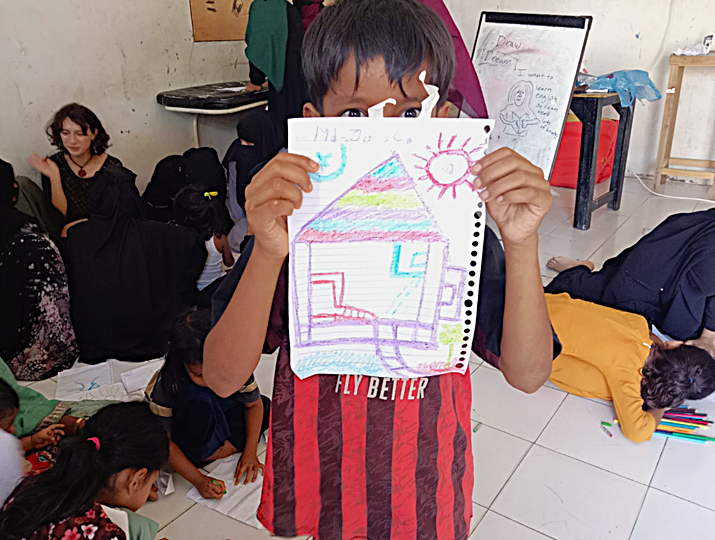
Both sisters still dream of building a life beyond the camp. During one class assignment, I asked the students to imagine their futures. Razia said she wanted to become a successful businesswoman. Noor imagined herself as an independent successful woman living in a large house and driving her own car. Together, we laughed as we tried to sketch the Ferrari she told me she would own someday.
Another pair of consistent regulars in class was a mother and daughter duo: Nalifa and Fatema. Nalifa was quiet and hesitant to participate, but she visibly brightened whenever her talkative-intelligent ten-year-old daughter spoke up in class. Her husband and son were regulars in the men’s class, making the family the only one who attended together each day.
One afternoon after class, Nalifa and her husband approached my colleague and I shyly carrying plastic cups filled with sweet soy milk and bubur kacang hijau (green bean porridge). They insisted we take the treats home with us. Back at the hotel we drank them slowly, reflecting on the generosity of a gift offered so freely despite the family’s limited means.
On any given day, leading class demanded tremendous levels of flexibility. But on the day when workers from IOM arrived to distribute hygiene buckets, that flexibility was pushed to its limits.
Before class, our liaison had warned us in a hushed tone, that aid distribution days can bring chaos as people compete for essential supplies.
Sure enough, not even fifteen minutes into class, shouting broke out outside the window. Through the chain links we saw a man and woman in a heated argument, a crowd forming around them. Attendance that day was sparse — just Noor, Razia, Nalifa, Fatema and another of the younger girls. Noor immediately ran out to join the crowd. Through the fence I watched her attempt to intervene in the fight by grabbing the shouting woman’s arms. Inside the classroom, the younger girls remained calm. Supplied with crayons and paper, they happily drew colorful henna flowers, tuning out the fight as if it were a standard occurrence.
Razia, on the other hand, had gone pale. As the yelling outside intensified, she curled into herself, pressing her palms against her ears, looking at me with frightened saucer eyes. I knew I was out of my depth. Trying to offer some distraction for her, I pulled out flashcards, and began flipping through them. Razia softly lowered my hands. “Please Ma’am,” she said, “I want to learn something new.”
I moved to the board, trying to scrape together some composure for the both of us, and improvised a lesson from a germ of an idea: want vs need. Together, me and Razia built examples until the discussion widened into a deeper question: What do all humans need?
For Razia, the idea of basic human rights was entirely new, but she approached it with care and reflection. Each point we discussed opened up new areas of reflection. I wrote: All humans have a right to safe places to live. Razia responded by describing a teenage girl in the camp who had recently been hospitalized after suffering abuse at home. Safety, she concluded, meant protection not only from external threats, but also from within the household. By then, Noor had returned and joined in. All humans are entitled to religious freedom, she responds by recalling their exile from Myanmar and the persecution they had fled.
All human beings have a right to education.
This, too, was immediate and lived: since leaving Myanmar, these clever curious girls had been cut off from formal schooling. In that small classroom, interrupted by noise and uncertainty, those abstract rights became grounded in the realities of their daily lives.
One of the most difficult aspects of working with refugees is the persistent sense that it is never enough — that, in the face of such overwhelming need, any effort feels like a drop in the bucket. Yet even within these constraints, there are strong reasons to believe that introducing English to Rohingya women can have a meaningful, lasting impact.
Most immediately, English can become a vital tool for those who are eventually resettled in Western countries, helping them advocate for themselves and navigate integration more independently. But even before resettlement, it is essential in their current reality of displacement.
According to discussions with Agustia Rahmi, founder of YSAP and former staff at UNHCR Indonesia, in the whole country, there are only three female Rohingya translators, meaning that most interactions from aid services and healthcare providers rely on male intermediaries. This can severely undermine the quality of translation. Women may feel uncomfortable discussing sensitive issues in front of male interpreters, particularly around sexual health.
As the Translators without Borders (TWB) research notes, euphemisms for body parts or symptoms are frequently misunderstood or mistranslated. And according to Agustia’s experience working directly with Rohingya women, male interpreters sometimes filter or soften information, whether consciously or unconsciously, particularly when issues involve violence. Increasing language skills could help women meet these needs while in displacement.
For Rohingya women in girls especially, this gap between policy and reality is not abstract. It compounds the same structural exclusions they already face in daily life — where even basic communication with aid and healthcare systems depends on male intermediaries, and where their voices can be softened, filtered, or even lost entirely in translation.
Without education, these silences deepen, narrowing their ability to ask questions, describe pain, or claim rights that already exist on paper but remain out of reach in practice.
It is in this context that the anti-rohingya sentiment in Aceh feels particularly insidious. The protesters in 2023 who flocked the Rohingya temporary shelter in Banda Aceh, demanding that they be removed, and the continued neglect of those had overlook both present realities and human dignity.
To see families who arrive with little more than the clothes on their backs, carrying the same hopes as anyone else: safety, dignity, and the chance to rebuild. And to see the women and girls sitting on dusty floors, drawing henna flowers and Lamborghinis — not as passive recipients of aid, but as people still imagining futures beyond it.
#The names in this story have been changed for privacy reasons
[1] Although this is the most up to date figure, it has likely dropped since May 2026 as increased cuts to aid from UNHCR have led many refugees to leave Aceh.
Perempuan Peduli Leuser (PPL) merupakan komunitas yang mewadahi perempuan untuk saling bertukar pikiran dan bersinergi dalam mengampanyekan isu-isu lingkungan.